

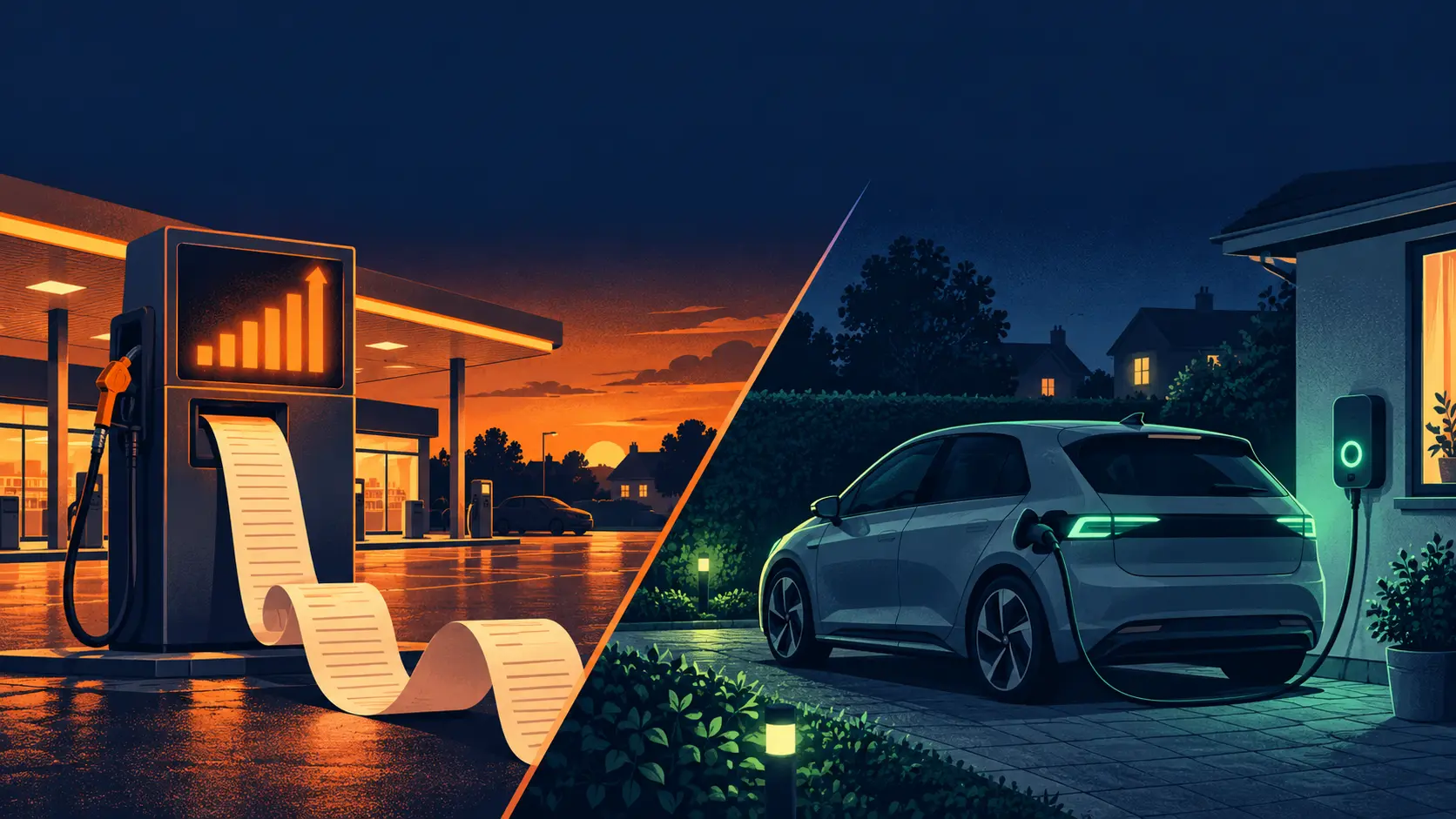
The new pay-per-mile tax has people panicking. The maths says calm down: an EV still costs a quarter of petrol per mile, and there are 18 months of tax-free miles left.
“Don’t you just love being taxed out of existence [sic]!?”
That was one driver’s take on X on 18 October (@PJW6466). More than half a million people saw it.
He was talking about eVED, the new Electric Vehicle Excise Duty. From April 2028, it charges 3p for every mile you drive an electric car.
Nobody likes a new tax. Fair enough.
But while everyone argued about a charge still 18 months away, something else happened at the pumps.
On 3 July, petrol averaged 150.5p a litre. By 11 October, it was 174.3p (Fuel Finder).
That’s nearly 24p a litre in one summer.
For a 40mpg petrol car, that adds about 2.7p to every mile. The EV tax adds 3p.
So petrol drivers just took almost the same hit, a year and a half early. No consultation, no Budget speech.
Does an EV still make sense once the tax lands? We ran the numbers.
What you actually save
Charge at home and you’re £1,752 a year better off than a petrol driver today. Once the tax kicks in, it’s £1,452.
Our assumptions: 10,000 miles a year, an EV doing 3.5 miles per kWh, and a 40mpg petrol car at today’s pump price.
Hat tip to @HughInvests, whose post on this did the rounds last week. We’ve updated his numbers with this month’s prices.
Off-peak home tariffs run at around 8p per kWh, and the October cap puts the standard rate at 26.32p. Public slow and fast chargers average 54p, and rapid chargers averaged 79p in September (Zapmap).
How you chargeSaving vs petrol today (£ a year)Saving vs petrol from April 2028 (£ a year)At home, off-peak tariff (8p)£1,752£1,452At home, standard rate (26p)£1,229£929Public slow and fast chargers (54p)£438£138Rapid chargers only (79p)£276 more than petrol£576 more than petrol
Per mile, it’s starker still. Petrol costs about 19.8p per mile.
Charging at home off-peak costs a little over 2p. Add the tax, and it’s just over 5p, roughly a quarter of the petrol cost.
And that’s being kind to petrol. We’ve frozen the pump price, and fuel duty is due to rise in January.
Switching from diesel? It’s about 25p a litre dearer than petrol right now, so your savings are bigger still.
Put the 3p in perspective
At 3p a mile, eVED is about half what petrol drivers already pay in fuel duty.
From 1 April 2028, electric cars pay 3p a mile, and plug-in hybrids pay 1.5p. The rate then rises with inflation each year (CAR).
The government’s own example: 8,000 miles costs an EV driver £240 a year in eVED. A petrol or diesel driver pays £480 in fuel duty alone.
Petrol isn’t standing still, either. Fuel duty is frozen until the end of the year, but a 3p a litre rise is pencilled in for 1 January 2027, unless the Budget moves it again (PetrolPrices).
Could 3p become 5p? A future Budget could raise it, like any tax.
But on paper, it’s a yearly rise in line with inflation. That’s it.
Until April 2028, every EV mile is tax-free. Enjoy the “today” column while it lasts.
How you’ll pay it
No black box, no tracking app. Just a mileage check at your MOT.
- You estimate your miles for the year ahead, then pay up front, twice a year, or monthly (GOV.UK).
- A tester reads your mileage at the MOT. Cars too young for an MOT run on your estimate until their first test (GOV.UK).
- Underestimate, and you top up. Overestimate and the credit rolls into next year.
- At 10,000 miles a year, that’s £25 a month.
Two things worth knowing:
- Buying used? Any unpaid miles stay with the car, so if the mileage has outrun the seller’s estimate, you pick up the difference (Which?). Ask about it as you’d ask about the service history.
- Leasing? The government is still working out how eVED applies to lease and rental cars (GOV.UK). We’ll dig into that in a future issue.
Most drivers are already in the top row
Nine in ten EV drivers can charge at home, according to a Department for Transport study run by Ipsos (Forecourt Trader). Three in four have their own wallbox.
So for most people, the top line of that table isn’t a best case. It’s just Tuesday.
No driveway? You can still win
Without a home charger, the target is simple: keep your average under about 59p per kWh.
That’s very doable.
Slow and destination chargers average 54p. Top up while you shop, eat, or work, and you still beat petrol, even after tax.
The margin’s thinner. But you’re ahead.
Rapid chargers are where it gets tricky. The network on the unit decides whether you win.
Believ charges 66p and Tesla’s open Superchargers 69p (Zapmap). Today’s break-even is about 69p, so Believ beats petrol and Tesla is level with it.
The dearest big network charges 92p. Put 30kWh in there, and you’ve paid about £10 more than at the cheapest, for the same electricity.
From 2028, the break-even drops to 59p. Even the cheapest rapid network, at 59p, is only level with petrol, unless you catch an off-peak deal.
So don’t build your week around rapid charging. Charge slow for the everyday and save rapid for long trips.
Used that way, they’re brilliant.
Want your own number? Take your old car’s fuel cost per mile, knock off 3p for the tax, and multiply by your EV’s miles per kWh.
That’s the most you can pay per kWh and still beat petrol.
Break-even price per kWh = (petrol cost per mile - 3p) x miles per kWh
For our example car: 19.8p minus 3p, times 3.5. That’s about 59p.
A thirstier EV doing 3 miles per kWh needs to stay under 50p. A frugal one doing 4 miles per kWh can pay up to 67p.
The verdict
The 3p tax is real. Nobody’s pretending it’s welcome.
But petrol drivers took almost the same hit this summer. And an EV charged at home still leaves you about £1,450 better off a year after the tax lands.
Until then? Closer to £1,750.
If this was useful, the newsletter is where these land first. One email a month, no spam, one click to leave.

One email a month for people who drive electric.
Lease tricks, charging costs and new tools before anyone else sees them. Posts like this one land in the inbox a few days before they land here.
